
Notes from AWP 2026
Why I have (rightfully) managed to avoid big conferences until now & some highlights

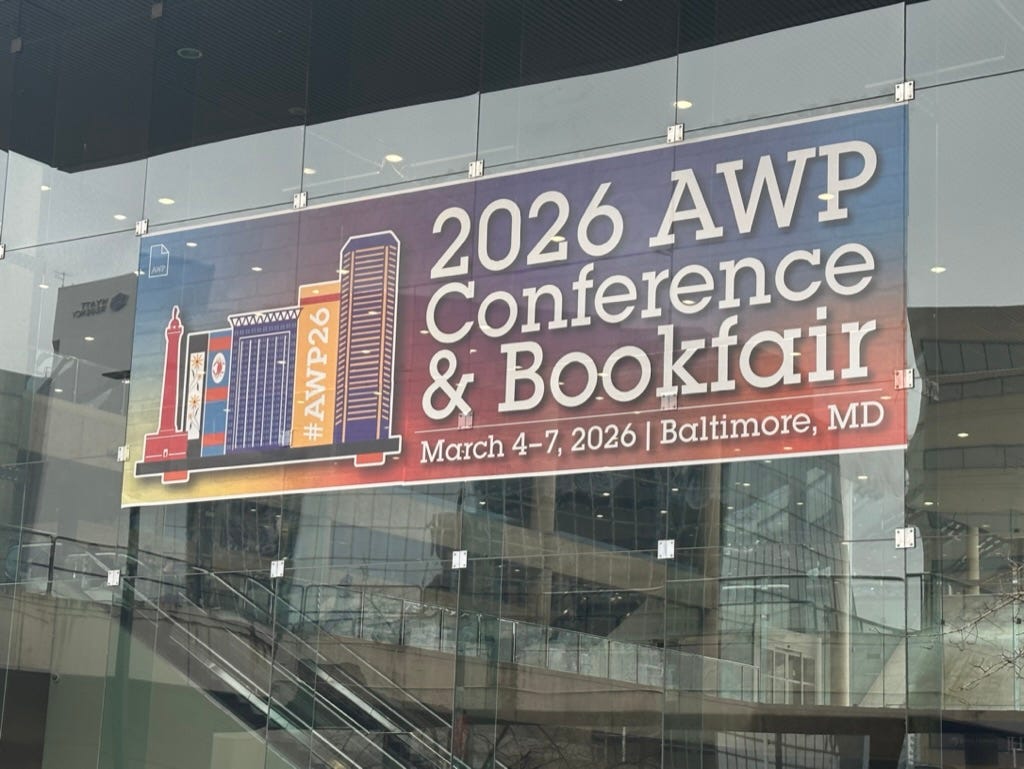
While there were a million pleasurable moments from AWP (the Association for Writers and Writing Programs), I am just not built for huge national conferences. If you’re anything like me, national conferences are a sensory nightmare—people everywhere, too many lights, SO LOUD—and it’s completely unavoidable. There is just no way to make a gathering of thousands of people less overwhelming. The only thing you can do is take care of yourself.
But I am not great at reading my body’s signals on a low sensory input day, so I was walking around the conference and not aware that my body needed things until I was shaking in my seat. Big yikes.
All that’s happening and the expectation is that you can still manage to overcome any potential anxiety to talk to potential publications or authors you admire. That you might be able to focus in the panels, maybe even learn something. And then if you’re me, traveling itself makes me anxious and I was in the car for several hours on my own?
LOL, guys, this was a hard no for me.
I promise, it’s not the specific conference. This is not AWP specific. I would have felt this way after any major convention. As a matter of fact, the best thing that happened because of COVID precautions was that in my final years of my PhD program and my years as a VAP, most of the big national conventions were held virtually. I was able to attend in a much more manageable for me way. Even if I was stressed out about being on a panel with a senior scholar, at least other parts of my experience were controlled: I could wear more comfortable clothes, sit in a comfy chair, have my favorite coffee. If I needed a second, I could briefly turn my camera off.
And still: there were moments that were so fantastic to me, caught like lightning bugs in a jar.
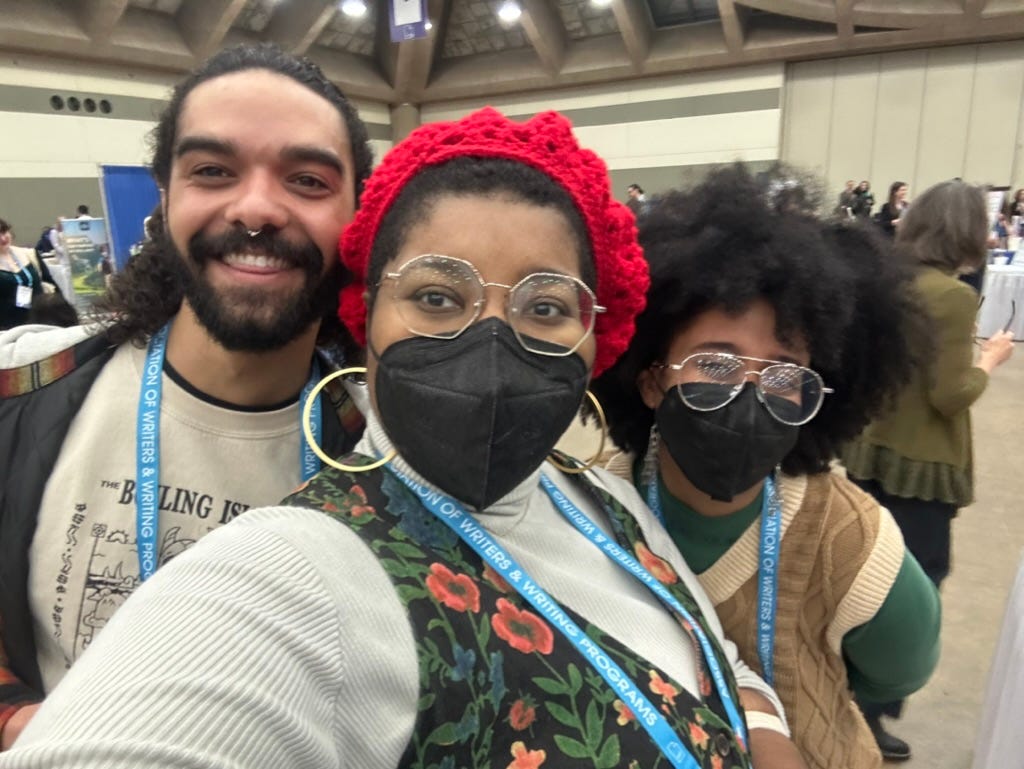
I walked straight into a friend from college, Cosima, my scholarship organization baby sibling, who I had not seen in person since I graduated. We recognized each other at the exact same moment, screamed, and fell into the best hug I’ve gotten since October. I felt so much pride bursting out of me. They were my top choice for the scholarship that year, they would enter as a first year as I was entering my fourth the next fall, and I was among the first they texted they got it. And now they’re at one of the biggest writing conventions in the nation. Love really knows no time boundaries.
A few moments after that, a girl at the Poets & Writers table stopped me and said, “This is probably weird, and you don’t know me, but I know you. We both went to UVA. I know your best friend. I was in Black Monologues. I was Ridley!” Micah, Black Monologues, and Ridley Scholarship were really all I needed to know. We embraced and as luck would have it, my baby sibling was only a few tables away. They had a joyful reunion, and then we all took a photo. Who knew so many of Uncle Ridley’s kids would grow up to be writers?
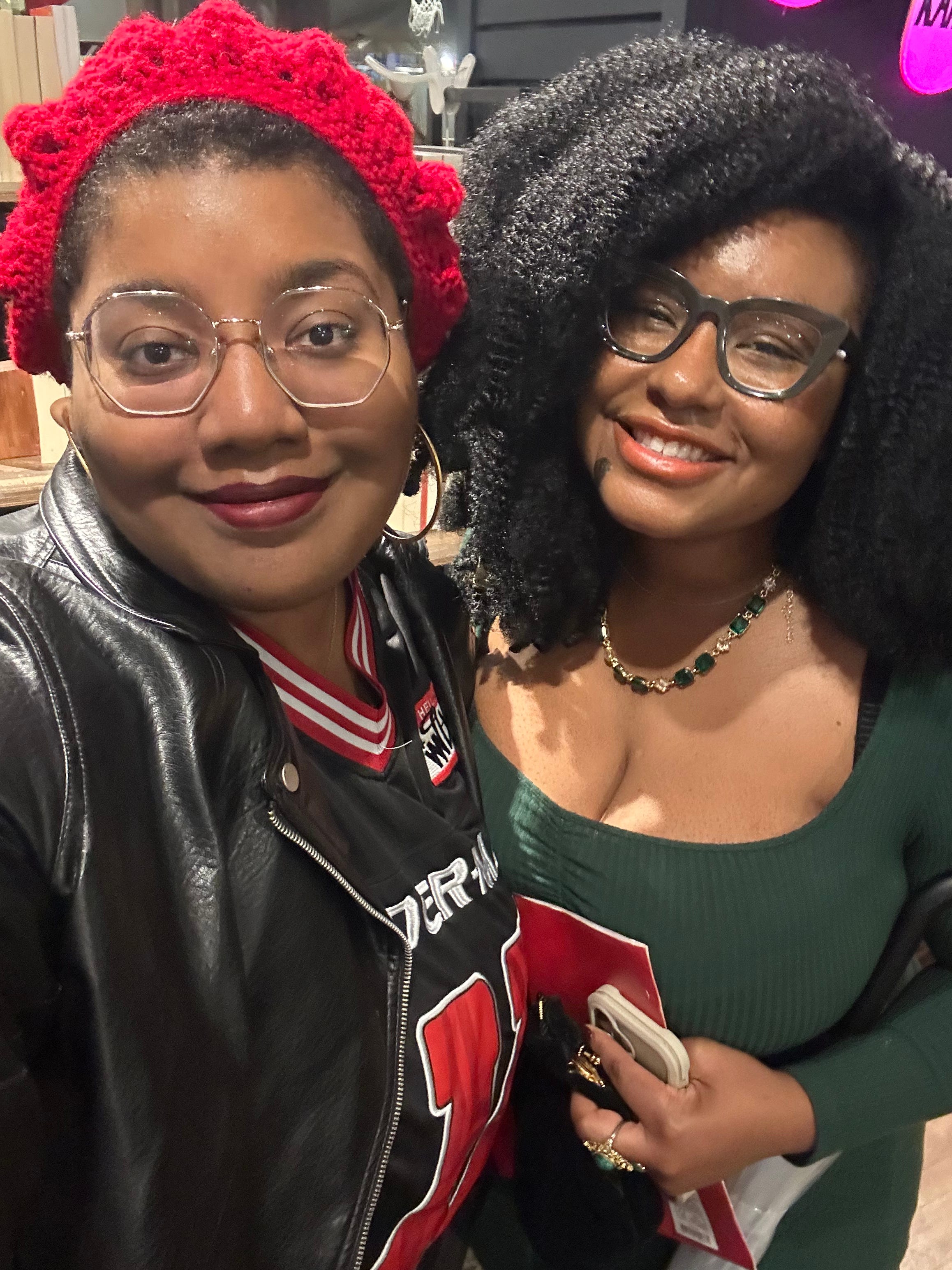
I met my homegirl, Exodus, after being mutuals on socials for years, and weekly writing buddies for the last couple months. We are very much your favorite Mississippi and Virginia sister-friends/living Barbie dolls.
Meg Pillow recognized me from Twitter days as I passed The Rumpus table, and we got caught up and chatted. She urged me to circle back when Roxane Gay would be there (she and her wife, Debbie, bought The Rumpus last year). I did circle back, but I couldn’t bring myself to speak. But let the record show I did wave at Roxane Gay.
I met some lovely Black girl MFA students—a bunch from University of South Carolina, and one from Emerson, who I invited to join me and the midnight & indigo editors for lunch. They all were the kind of hopeful that makes me think tomorrow might be okay.
I met the editor-in-chief of midnight & indigo in person for the first time! (I met my other co-editor, Jina, last August.) I’m grateful for the time I got to spend with them, both of whom I consider mentors. I love that I’m contributing to the landscape of publishing in a way that centers the voices of Black women with them. I’m proud to be on their team.
My favorite exchange from the whole trip was with the poet Patricia Smith. I stood behind her in the registration line on Wednesday, but I was too shy to say anything. A young woman closer to my age ran up to her and greeted her with the biggest hug. Smith returned the warmness, and it made me think she’d be equally kind if I said hello.
I didn’t catch her again until the last morning when I was doing my last pass through the book fair. I managed to get myself to say hello, tell her I loved her speech from last year’s national book awards, and congratulate her on the win. As I suspected, she responded graciously and with kindness, then asked if I was a poet.
I shook my head, telling her that I can’t write them. I write two poems a year, and each of them are so bad I think I’ll never write again.1 She laughed and replied that anyone could write poems. I didn’t disagree, but certainly they aren’t necessarily good.
She chuckled again and said, “That doesn’t matter. It’s fun. When you want to try it out again, I’ll show you how fun it can be.”
I thought about that conversation for a while this morning, trying to puzzle out why it made me so happy.
Then it hit me: Patricia Smith still loves writing. Writing is still fun for her. Writing can be fun for you your whole life, if you let it.
This thing that I chose, this thing that chose me, can be a source of great joy for all my days.
I’ve never heard anything that gave me more hope for every version of myself I will be from now until I’m called home.
About The Author
If you’re new here and you don’t want to do all that clicking to find out what I’m about: I’m Dr. Ravynn K. Stringfield, a writer, editor, artist and former Peanut Fest Queen from Suffolk, Virginia. I am the author of two novels for young adults, Love in 280 Characters or Less (Feiwel & Friends, 2025) and Love Requires Chocolate (Joy Revolution, 2024). I am a product of Virginia public schools (Suffolk Public Schools) and universities (University of Virginia), all the way up to my PhD in American Studies from William & Mary. I’ve been published in a variety of venues for the last six years—book collections, magazines, scholarly journals—but most importantly, I’m a life long reader and a maker of beautiful things.
More Like This
Forgive me for this aside but in Namwali Serpell’s On Morrison, she says of Toni Morrison’s poetry: “Quiet as it’s kept, Toni Morrison’s poetry is not good. As far as I know, she published only seven poems in her lifetime, and there’s a reason you probably haven’t heard about them.” (262) Listen. LISTEN. All I’m saying is, sometimes God doesn’t give you particular talents or things because He doesn’t want you to get too powerful. The last essay of this collection is called “On Monuments,” and in it, Serpell says: “Now, Toni Morrison was not averse to monuments. First of all, she was a diva. She knew the worth of her work and was unabashed about being honored for it.” (307) Now, imagine if that lady could have also written poetry. Chile. As a final aside, everyone who is engaging in whatever that Threads commotion was over the Cannonball episode asking whether we were making Toni Morrison a saint, should read that essay. Serpell gives us the take we need. fin.
Sorry I didn’t see you but I did meet Exodus. What a sweetheart.
I hear you on conferences! I have had multiple dreams lately where I'm at the American Library Association conference and these are definitely stress dreams. I'm so glad you had these beautiful moments in the middle of all that sensory overwhelm. And Meg Pillow! She's one of my scholarwritermom role models.